
Why Does Your Acupuncturist Look at Your Tongue?
What your tongue can tell us through the lens of Traditional Chinese Medicine.
4 MIN READ · TRADITIONAL CHINESE MEDICINE
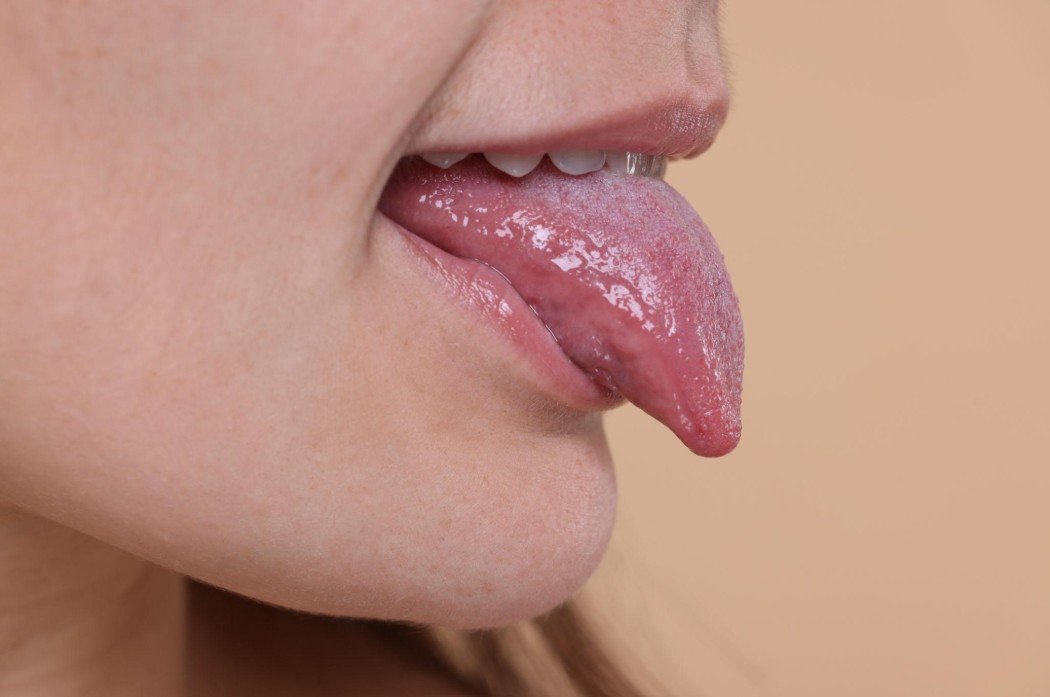
A natural, close-up showing someone's tongue, with soft lighting and a neutral background.
Your tongue tells a story.
If you've ever visited an acupuncturist, you may have been asked to do something unexpected: stick out your tongue!
It might seem unusual, but in Traditional Chinese Medicine, observing the tongue has been part of the traditional assessment process for centuries.
So, what exactly are we looking for?
Your Tongue Through the Lens of TCM
In Traditional Chinese Medicine, the body is viewed as an interconnected system. Rather than focusing only on individual symptoms, practitioners look for patterns that may help explain how different aspects of your health relate to one another.
Tongue observation is one of several traditional assessment methods used to explore these patterns.
A practitioner may observe your tongue's color, shape, coating, and moisture. Each characteristic is interpreted within the framework of TCM and considered alongside your symptoms, health history, and other findings.
What Do We Look For?
1. Tongue Color
In TCM, tongue color is traditionally associated with the state of Qi and Blood. Practitioners may observe whether the tongue appears pale, pink, red, or purplish when considering different patterns.
2. Tongue Shape
Is the tongue thin, swollen, or marked by indentations along the edges?
These characteristics may be interpreted in relation to traditional patterns involving digestion, fluids, and nourishment.
3. Tongue Coating
The coating on the tongue is another important observation. Its thickness, color, and distribution are traditionally considered when evaluating patterns associated with the digestive system.
4. Tongue Moisture
A tongue may appear dry, moist, or unusually wet. In TCM, these observations are considered in relation to how the body manages and distributes fluids.
Can Your Tongue Really Tell Us About Your Health?
Your tongue can offer useful observations, but it's important to understand the distinction between traditional interpretation and modern medical diagnosis.
In TCM, tongue findings are interpreted as part of a broader pattern assessment. However, specific tongue appearances have not been reliably established as diagnostic indicators of particular internal organ imbalances or medical conditions.
Tongue observation is therefore one piece of the picture—not a diagnosis on its own.
Changes in tongue appearance can also have many everyday explanations, including food, beverages, oral hygiene, medications, and certain medical conditions.
Why Does This Matter for Your Acupuncture Treatment?
At Shen Point, your treatment begins with understanding you as an individual.
Along with discussing your symptoms, health history, sleep, digestion, stress levels, and other concerns, traditional assessment methods such as tongue observation may help inform your personalized acupuncture treatment.
This whole-body perspective is one of the defining principles of Traditional Chinese Medicine.
A Little Something to Think About
The next time your acupuncturist asks you to stick out your tongue, you'll know there's a reason behind the request!
It's one of the many ways Traditional Chinese Medicine approaches the body through observation, conversation, and individualized care.
